

Overview of The Social Network
Fincher’s film tells the story of Mark Zuckerberg’s early Harvard days, the creation of “Thefacebook,” and the lawsuits that followed. It moves between deposition rooms and flashbacks, stitching together conflicting testimonies to explore who gets credit, who gets paid, and who gets left behind. It is sleek, witty, and unnervingly relevant to anyone building something online.
- Genre(s): Biographical drama, legal drama
- Release date (UK): 15 October 2010
- Age classification (UK): 12A
- Run time: 120 minutes
Main Characters
Mark Zuckerberg (Jesse Eisenberg): Brilliant, socially awkward, and relentlessly focused, Mark is portrayed as a builder obsessed with speed and shipping. Eisenberg plays him with clipped intensity: a founder whose competitive edge is both his superpower and his social kryptonite. For marketers, he embodies the uncomfortable truth that clarity of vision often demands brutal prioritisation.
Eduardo Saverin (Andrew Garfield): The early business lead and Mark’s friend, Eduardo provides the first cash infusion and attempts to shape strategy and monetisation. Garfield lends warmth and moral weight; Eduardo’s arc shows the risks of mismatched expectations, shaky shareholder agreements, and the perils of scaling governance too late. 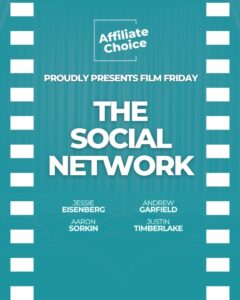
Sean Parker (Justin Timberlake): The Napster co-founder appears as the seductive evangelist of blitzscale culture — network effects, Silicon Valley access, and brand swagger. He spots the lightning in the bottle and encourages ambition. To affiliates and founders, Sean represents the allure (and hazard) of rapid expansion, dilution, and narrative control.
Cameron & Tyler Winklevoss / “the Winklevii” (Armie Hammer) and Divya Narendra (Max Minghella): The rowing twins and their partner claim idea theft. Their presence underscores how execution outruns ideation in tech, while also highlighting the legal minefields around NDAs, IP, and contracts — all relevant when you’re negotiating exclusives, tracking assets, or joint ventures.
Erica Albright (Rooney Mara) and Marylin Delpy (Rashida Jones): Erica’s early breakup frames the film’s emotional cold open, while Marylin, the junior lawyer, offers the clearest lens on consequences. Together they ground the story: brand and product are built by humans, and people remember how you made them feel.
Movie Soundtrack
Trent Reznor and Atticus Ross deliver a moody, electronic score that hums with tension and forward motion. From the haunting piano motif of “Hand Covers Bruise” to the pulsing textures that underscore late-night coding and deposition showdowns, the music functions like an adrenaline drip. It’s sparse, modern, and meticulously engineered, mirroring the film’s themes: iteration, efficiency, and precision. Notably, the duo’s work here helped mainstream the minimalist, synth-driven sound now common in tech dramas, and the soundtrack won the Academy Award for Best Original Score. It’s the perfect aural companion to a hustler’s to-do list.
Why Watch on Film Friday
For affiliate marketers, business owners, C-suite leaders, and established marketeers, The Social Network is a mirror and a warning. It distils core lessons: ship fast but paper the basics; own your data and your narrative; incentivise fairly; and secure agreements before growth exposes the gaps. You’ll see the brutal clarity of positioning (“drop the ‘The’ — cleaner”), a masterclass in virality (scarcity, social proof, campus-by-campus rollout), and the consequences of misaligned expectations between product and commercial teams. It also illuminates stakeholder mapping: investors, partners, co-founders, early employees, and litigants each shape brand destiny as much as ICPs and funnels do.
For leadership, the film shows how culture forms in the crucible of velocity. Boundaries blur; roles shift; governance lags behind growth. For affiliates, there’s a direct analogue in offer ownership, attribution rights, and the race to secure exclusive deals before competitors replicate your funnel. Ultimately, the film asks a strategic question every operator must answer: are you optimising for control, valuation, or impact — and what are you willing to trade?
Viewers’ Guide
Notable quotes: “If you were the inventors of Facebook, you’d have invented Facebook.” It’s a ruthless reminder that shipping beats pitching. Another keeper is the film’s tagline: “You don’t get to 500 million friends without making a few enemies,” a neat summary of the reputational tax on hypergrowth. Watch for Sorkin’s dialogue rhythms; even the deposition scenes feel like fencing bouts — thrust, parry, riposte.
Interesting facts: The screenplay adapts Ben Mezrich’s book The Accidental Billionaires, though Sorkin constructed many scenes from depositions rather than aiming for documentary fidelity. Armie Hammer’s dual performance as both Winklevoss twins used split-screen and a body double, an elegant technical solve that mirrors the film’s fascination with engineering. The rowing sequence, set to a glitchy rendition of Grieg’s “In the Hall of the Mountain King,” is a playful nod to the twins’ precision and privilege.
Similar Films
- Steve Jobs (2015): A three-act backstage portrait of product launches and founder myth-making, rich with lessons on positioning and persuasion.
- Moneyball (2011): Turning data into competitive edge; a case study in contrarian strategy, resource constraints, and stakeholder buy-in.
- The Big Short (2015): Complex systems explained with style; shows how narrative clarity can sell difficult ideas to sceptical audiences.
- The Founder (2016): McDonald’s expansion through process innovation and franchising; a study in brand, IP, and execution over invention.
- War Dogs (2016): Sales swagger and risk management in volatile markets; entertaining and cautionary in equal measure.
Snack Idea
Lean into the dorm-room start-up vibe: shareable pizza (UK: margherita with chilli oil; US: classic pepperoni), bowls of salted popcorn, and a “hacker fuel” trio — fizzy drinks, chilled cold-brew, and water. For a playful nod to the coding marathons, add instant ramen cups with lime and spring onion, or go international with tortilla chips and fresh salsa for sustained nibbling while you take notes on quotes and tactics.
Conclusion: Build Faster, But Paper the Basics
The Social Network is pacey, provocative, and painfully honest about the costs of winning online. For affiliate marketers and business owners, it’s a masterclass in virality, brand crispness, and ruthless prioritisation — and a sober briefing on equity, contracts, and culture. Watch it this Film Friday to sharpen your instinct for distribution, to question your cap table and partner terms, and to recommit to execution that’s as rigorous ethically as it is tactically. Then close the laptop, sketch your next funnel, and ship.
The Social Network FAQ
What is The Social Network about?
The Social Network (2010) tells the story of how Facebook was founded by Mark Zuckerberg while studying at Harvard University. The film explores themes of ambition, innovation, betrayal, and the human cost of success. For affiliate marketers and entrepreneurs, it serves as a case study in scaling ideas, protecting intellectual property, and building digital communities from the ground up.
Who directed and wrote The Social Network?
The film was directed by David Fincher and written by Aaron Sorkin, based on Ben Mezrich’s book The Accidental Billionaires. Fincher’s meticulous style and Sorkin’s sharp dialogue combine to create one of the most compelling depictions of modern entrepreneurship ever put to screen.
How does The Social Network relate to affiliate marketing?
Affiliate marketing thrives on innovation, digital networking, and strategic partnerships — all central themes in The Social Network. The film highlights how timing, execution, and platform control can determine long-term success. Much like Facebook’s early viral growth, affiliate marketers must understand audience psychology, create frictionless user journeys, and scale without compromising integrity.
What business lessons can affiliate marketers learn from The Social Network?
Several key takeaways stand out: the importance of securing legal agreements early, maintaining clarity in partnerships, and valuing both product innovation and monetisation strategy. The film also reminds marketers that storytelling drives brand adoption — and that speed should never come at the cost of ethics or sustainability.
Who are the main characters in The Social Network?
The central figures include Mark Zuckerberg (Jesse Eisenberg), Eduardo Saverin (Andrew Garfield), Sean Parker (Justin Timberlake), and the Winklevoss twins (Armie Hammer). Each represents a different archetype of business life — the coder, the investor, the visionary, and the challenger — making the film an insightful reflection of how diverse mindsets collide in high-growth ventures.
Why is The Social Network still relevant for modern marketers?
In an age dominated by social media and influencer ecosystems, the film remains a blueprint for understanding virality, network effects, and digital reputation. Its portrayal of branding, user acquisition, and platform trust echoes today’s affiliate landscape, where credibility and transparency are as vital as conversion metrics.
What is the soundtrack of The Social Network and why does it matter?
The film’s score by Trent Reznor and Atticus Ross uses minimalist electronic textures to evoke focus, innovation, and unease — emotions that mirror entrepreneurial intensity. For business leaders and creatives, the soundtrack reinforces the film’s rhythm of relentless progress, a feeling familiar to anyone scaling a brand or optimising campaigns.
What famous line from The Social Network applies to business?
The standout quote, “If you were the inventors of Facebook, you’d have invented Facebook,” captures the essence of execution over ideas. In affiliate marketing and business, this translates to: those who take action — test, refine, and deploy — will always outpace those who only plan or observe.
Is The Social Network suitable for entrepreneurs and business students?
Absolutely. The film serves as an engaging case study in entrepreneurship, business ethics, brand positioning, and startup culture. It’s ideal for anyone studying marketing, digital innovation, or leadership — or for any affiliate professional looking to understand the dynamics of scaling in competitive environments.
What similar films can affiliate marketers watch after The Social Network?
Viewers who enjoyed this film might also like Steve Jobs (2015), Moneyball (2011), The Founder (2016), and The Big Short (2015). Each explores business innovation, risk, and the psychological tension of challenging the status quo — much like the day-to-day reality of performance marketing and entrepreneurship.