


Introduction: When Prosperity Meets Peace of Mind
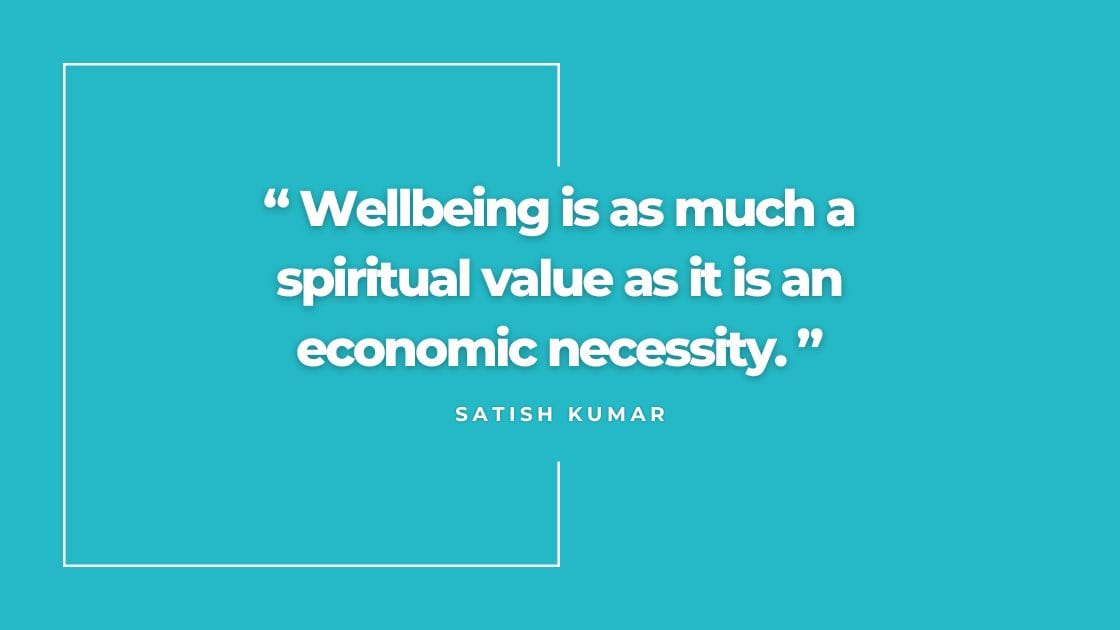
In an age where productivity and profit often dominate our daily pursuits, Satish Kumar’s profound words serve as a much-needed reminder: “Wellbeing is as much a spiritual value as it is an economic necessity.” As a former monk turned peace activist and editor of Resurgence & Ecologist, Kumar has long championed the idea that personal happiness and planetary health are inseparable. His philosophy bridges two worlds that modern society too often keeps apart — the spiritual and the economic.
This quote stands out as both timeless and urgent. In today’s fast-paced culture, success is frequently measured in financial gain, yet true fulfilment remains elusive. Kumar’s message challenges that imbalance, urging us to recognise that wellbeing is not a luxury or an afterthought — it’s foundational to both sustainable economies and meaningful lives. His insight encourages readers to reflect on their own definitions of success: can a life be prosperous without inner peace? Can a business truly thrive without nurturing the wellbeing of its people? 
For professionals, entrepreneurs, and dreamers alike, this quote invites a moment of pause — a chance to rethink what growth really means. Beyond numbers and metrics lies a deeper kind of wealth: the harmony between mind, purpose, and planet. That’s where real motivation begins.
“Wellbeing is as much a spiritual value as it is an economic necessity.” in Context
Satish Kumar’s quote emerges from his lifelong dedication to connecting the dots between spirituality, ecology, and economics. Born in India and inspired by Mahatma Gandhi’s principles of simplicity and self-sufficiency, Kumar has spent decades advocating for a shift in global consciousness — one where humanity values balance over excess and compassion over competition. His statement on wellbeing encapsulates this worldview perfectly, reminding us that economic health and human happiness are deeply intertwined.
The context behind this quote lies in Kumar’s holistic approach to modern living. He argues that the spiritual dimension of wellbeing — mindfulness, connection, purpose — directly fuels economic resilience. After all, societies and businesses flourish when individuals feel valued, rested, and connected to something larger than themselves. Ignoring this relationship, he warns, leads to burnout, inequality, and ecological decline.
When viewed through this lens, Kumar’s words transcend philosophy; they become a call to action. For business leaders, this means embedding wellbeing into organisational culture, not as a box-ticking exercise but as a core strategy for long-term success. For individuals, it’s an invitation to see self-care not as indulgence but as investment. The intersection of spirituality and economy, Kumar teaches, isn’t an abstract ideal — it’s the blueprint for a better future, one that balances prosperity with peace.
Finding the Deeper Meaning
At its core, Satish Kumar’s quote — “Wellbeing is as much a spiritual value as it is an economic necessity” — speaks to the essence of balance. It reminds us that true success is not achieved by financial growth alone, but by nurturing the human spirit that fuels it. When we strip away the complexities of modern life, what remains is a simple truth: people who feel centred, valued, and fulfilled are more capable of building prosperous and sustainable futures. The harmony between spiritual contentment and material achievement is not a contradiction; it’s a partnership.
From a psychological perspective, wellbeing underpins everything from motivation to performance. Studies in positive psychology, such as those by Martin Seligman and Mihaly Csikszentmihalyi, have long shown that happiness and meaning enhance productivity and creativity. Likewise, philosophical traditions from both East and West have explored how inner peace and purpose lead to ethical decision-making and enduring resilience. Kumar’s insight connects these ideas beautifully, suggesting that an economy detached from spirituality risks losing sight of what truly matters: people, purpose, and planet.
Modern interpretations of this philosophy can be seen in movements towards mindfulness at work, conscious capitalism, and the growing focus on mental health in the workplace. It’s no coincidence that businesses prioritising employee wellbeing often outperform their competitors. The deeper meaning here is that spiritual awareness and economic success are not opposing forces — they are complementary energies that, when balanced, generate genuine prosperity.
Relevance to Life and Business
In today’s digital-first world, where affiliate marketers, entrepreneurs, and business professionals constantly chase metrics, Kumar’s message offers a timely recalibration. Wellbeing is not a distraction from productivity; it is the foundation upon which sustainable success is built. In affiliate marketing, where results often depend on consistency, creativity, and adaptability, burnout can be a real threat. The spiritual side of wellbeing — cultivating patience, gratitude, and clarity — is what allows individuals to stay focused and resilient in the face of uncertainty.
For business owners, this means viewing wellbeing as an asset rather than an expense. Investing in yourself or your team’s mental and emotional health can yield stronger relationships, smarter decisions, and greater innovation. Encouraging balance — through mindful breaks, purpose-driven goals, and an empathetic work culture — can enhance both individual satisfaction and collective output. The affiliate industry, often characterised by constant testing and optimisation, can take great lessons here: sometimes, the best performance boost comes not from tweaking a campaign, but from taking care of the person running it.
On a broader level, Kumar’s philosophy reminds us that the wellbeing of people and the planet are intertwined with the wellbeing of business. Companies that ignore this truth may succeed briefly, but those that nurture it build legacies. Whether you’re an affiliate marketer fine-tuning your latest offer, a start-up founder managing growth, or an employee seeking purpose, the lesson is universal — success and serenity thrive best when cultivated together.
Business Connection
When we translate Satish Kumar’s words into the business realm, they become a guiding principle for long-term sustainability and authentic growth. Every entrepreneur, affiliate marketer, or ambitious professional has faced moments of scarcity, self-doubt, or poor decisions that threatened to derail progress. It is in these moments that the idea of wellbeing as both spiritual and economic becomes most powerful. True business success demands inner balance just as much as strategic thinking. Without clarity, resilience, and self-belief, even the best ideas struggle to take flight.
Consider how many times you have worked late, chasing deadlines or revenue targets, only to find yourself exhausted and uninspired. The truth is, consistent progress rarely comes from constant pressure; it comes from a centred state of mind. That’s why the most successful leaders and marketers prioritise mental wellbeing alongside financial metrics. They understand that innovation and confidence thrive in a calm, focused mind. When you nurture your inner wellbeing, you create a fertile environment for opportunity, creativity, and better decision-making.
This week, try one simple shift: dedicate time each day to reconnect with your purpose. Whether that’s a quiet walk before work, journalling about what drives you, or reviewing your goals from a place of gratitude, this mindful check-in helps you align your business goals with your personal values. As Kumar reminds us, the spiritual and the economic are inseparable. By protecting your inner state, you strengthen your outer success — and that’s a lesson worth practising daily.
Conclusion: Prosperity Begins Within
In the end, Satish Kumar’s wisdom reminds us that the journey to prosperity begins not with more resources, but with more awareness. “Wellbeing is as much a spiritual value as it is an economic necessity.” These words carry weight because they ask us to redefine success — not as the endless accumulation of wealth, but as the harmony between our ambition and our peace of mind. When we bring this balance into our work, we create not only profit but purpose.
As you move through this week, remember that your greatest investment is not the latest marketing tool or business trend, but your own wellbeing. It fuels every decision, every partnership, and every creative idea you put into the world. Take this as your cue to slow down, realign, and build from within. Because when your inner world is steady, your outer achievements naturally follow. For more insights on how to blend purpose with profit in your professional journey, visit Affiliate Choice — where wisdom and business meet.