

I still remember a childhood with only four TV channels (and later a fifth that no one could tune in to!), 8-bit video games, and phones attached to the wall. Fast forward to today: I can chat with an AI that writes poetry and creates artwork on command. It’s genuinely hard to fathom how, within one lifetime, we leapt from the world of my youth into this sci-fi present. I find myself incredulous at the contrast. For most of human history – from biblical times through medieval centuries – life plodded along with glacial change. Generations could live and die in a world that looked very much like their great-grandparents’. Yet here I am, born in the 20th century, now watching algorithms draw paintings and cars drive themselves. It feels as though time itself has accelerated. And indeed, historians note that we do live in an unusually fast-changing era: technological change used to be extremely slow (our ancestors often used the same tools in old age that they learned in childhood) – but now, for recent generations, innovations that were unimaginable in youth have become common later in life. Little wonder I’m struggling to wrap my head around it all. 
How did humanity go from centuries of gradual change to exponential advancement almost overnight (at least by historical standards)? In this article, I’d like to share my personal musings on that question. I’ll stroll through history – reflecting on the stagnant ages and the sparks that finally ignited progress. I’ll consider the current whirlwind of exponential growth (the “hockey stick” of human progress). I’ll explore the shift from the Information Age I grew up in to the dawning Intelligence Age of AI and biotechnology. And I’ll ponder what it all means for me personally – as someone trying to make sense of it as a human and as a marketer by profession.
If you sometimes feel overwhelmed (or awe-struck) by the pace of change, you’re not alone. I certainly do. Let’s start by looking back to a time when nothing moved fast.
Looking Back Through History
A long-term timeline of technology illustrates how slowly innovation unfolded for most of human history – tens of thousands of years between early breakthroughs like fire or the wheel – versus the sudden spike of change in recent centuries. Major inventions (from steam engines and vaccines to the internet) cluster in the modern era, giving the timeline a dramatic “hockey stick” shape.
For millennia, change was measured in centuries, not years. In biblical times, and even through the medieval era, daily life for the average person didn’t alter much across generations. A peasant farmer in AD 1200 had more in common with one from AD 600 than we modern folks might imagine – they tilled the soil with similar ploughs, lived by the same sunrise-to-sunset rhythms, and passed down skills unchanged for ages. Innovation was sporadic and slow. Humanity did make advances (the wheel, iron tools, watermills, etc.), but they were spaced out over such long periods that they barely disturbed the wider status quo. As one science writer put it, the tragedy of history is that for “tens of thousands of years, people toiled, starved, suffered, and died” with no dramatic progress to show for it. Everything was awfully static for a very long time.
Naturally, I wonder: why didn’t progress happen sooner? What held humanity back during those long centuries of relative stagnation? A few factors come to mind:
- Religious constraints: In earlier eras, strict religious dogma often dictated the boundaries of knowledge. Questioning the accepted worldview could be dangerous – the famous trial of Galileo by the Church for advocating heliocentric astronomy is a case in point. When new ideas were branded heresy, scientific curiosity was discouraged, slowing the march of progress.
- Monarchical and feudal power structures: Medieval society was dominated by kings, queens and feudal lords who valued stability and control. There was little incentive for radical innovation in a system where social order (and the monarch’s authority) rested on tradition. In many cases, monarchies and empires actively suppressed change that might upset the hierarchy. Serfs and commoners had neither the education nor the freedom to experiment with disruptive inventions – and any genius tinkerer born in a village workshop had slim chances to spread a new idea across the realm.
- Limited knowledge circulation: Perhaps most importantly, there was no easy way to share and build upon knowledge. Before the modern era, books had to be copied by hand; ideas spread at the speed of a horse or a ship. Without printing presses, telegraphs or the internet, a breakthrough discovered in one place might remain isolated for generations. It’s telling that once Johannes Gutenberg introduced the printing press in the 15th century, the rediscovery and sharing of knowledge vastly accelerated. In earlier centuries, a brilliant insight could flicker out in obscurity, whereas later on, print technology would place new ideas “in the hands of every literate European” and beyond.
Through the late Middle Ages, these constraints slowly began to loosen. The Renaissance (14th–17th centuries) saw a revival of learning and arts – aided by that newfangled printing press which churned out books and pamphlets by the thousands. Knowledge started flowing across borders; literacy rose; the Scientific Revolution took shape as thinkers like Copernicus, Galileo and Newton questioned old assumptions and used observation and experiment to understand the world. It still took centuries, but humanity’s toolbox was filling up with the prerequisites for rapid progress: widespread knowledge, a spirit of inquiry, and gradually, more open societies.
Then by the 18th and 19th centuries, the stage was set for an explosion. The Industrial Revolution hit like a lightning bolt. We learned to harness steam power, coal, and electricity; we invented machines to spin cloth, locomotives to span continents, and eventually engines and factories to multiply human labour. For the first time in history, economic output and population surged noticeably within a single century. In fact, if you plot world GDP per person over time, it was flat for thousands of years – and then around the 1800s it turns sharply upward. One astute essayist summarised it wryly: “Everything was awful for a very long time, and then the Industrial Revolution happened.” In other words, after ages of little change, humanity suddenly hit the gas. This was the dawn of something fundamentally new: the age of exponential growth.
The Age of Exponential Change
Since the 1800s, progress hasn’t just continued – it’s accelerated at a dizzying rate. Innovations now build on each other, compounding like interest on a loan. Instead of a slow, linear climb, human development resembles that hockey stick curve – a long flat handle (the pre-industrial age) followed by a sharply rising blade (the modern era). We live on that steep curve where change feeds on itself. Each invention paves the way for the next faster invention. This is the essence of exponential growth: a self-amplifying cycle where improvements enable even more improvements, causing an explosion of progress.
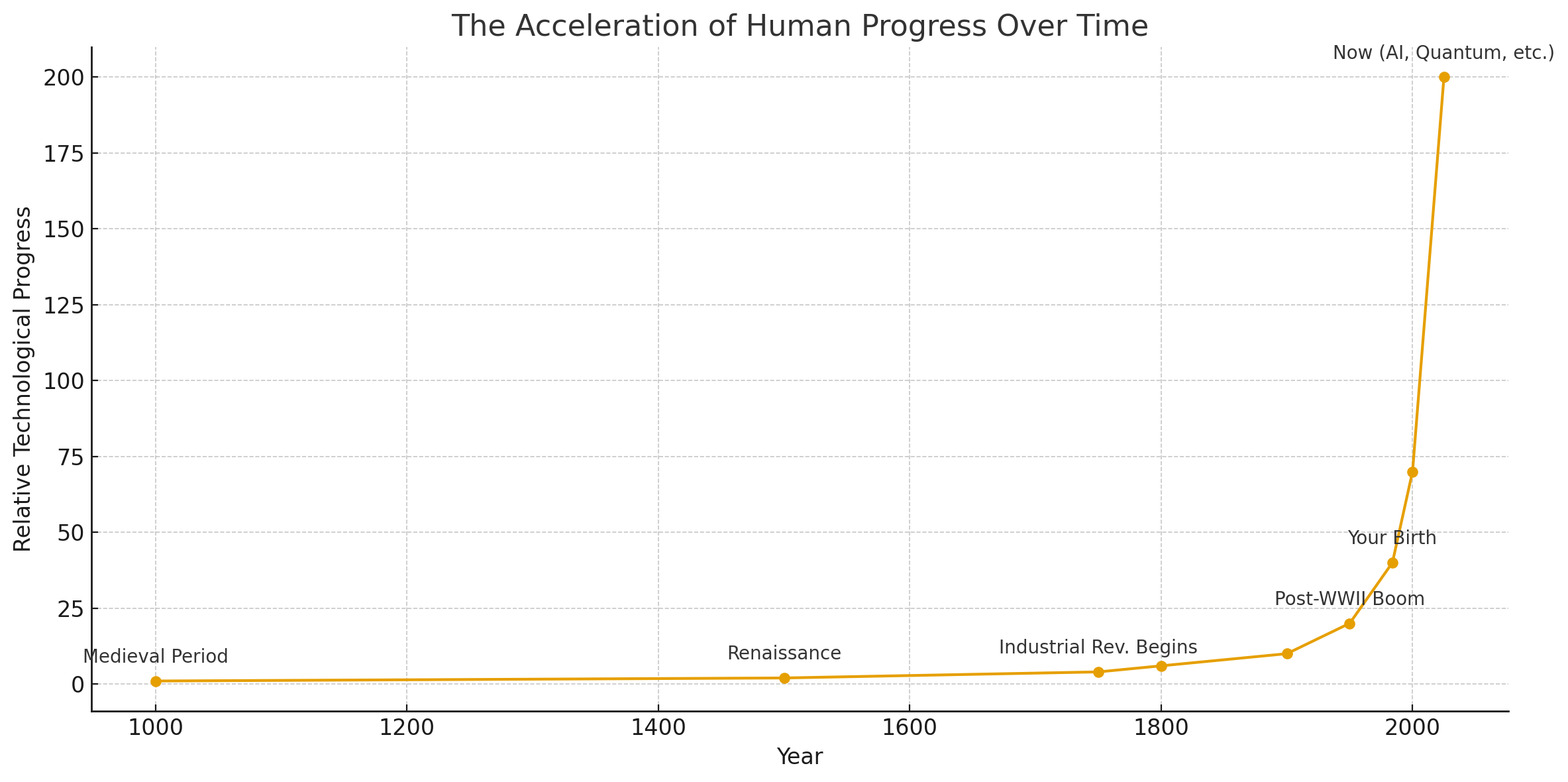
Futurists actually have a term for this phenomenon: accelerating change – the observed exponential increase in the rate of technological change in recent history. In simpler terms, technology isn’t advancing at a steady pace; it’s speeding up. And it could speed up even more in the future. We’ve seen it with computing power: Moore’s Law famously noted that the number of transistors on a microchip (a proxy for computing power) doubles roughly every two years, an exponential growth pattern that held for decades. That means your computer from two years ago is half as powerful as a new one today – and this doubling trend repeated again and again, leading to today’s machines being millions of times more powerful than those of the 1970s. This kind of compounding advance is now happening across multiple fields.
The results are astonishing. Technologies that would have seemed like magic to our ancestors are commonplace to us. Consider transportation and exploration: in 1903 the Wright brothers managed the first powered flight – a frail biplane airborne for all of 12 seconds. A mere 66 years later, in 1969, humans walked on the Moon. Unbelievably, there were people who witnessed both milestones in their lifetime. The world went from horse-drawn carriages to jet airliners in one human lifespan. Or consider communication: for thousands of years, if you wanted to send a message, you gave a letter to a courier on horseback. Today, I can send a WhatsApp text across the globe in a second, or hop on a Zoom call with colleagues continents away. In the span of a few decades, we went from posting letters to posting tweets.
The curve keeps steepening. Many metrics of human progress – from energy use, to number of patents, to population – show this “hockey stick” uptick in the modern era. It’s as if humanity spent a long time warming up, and now we’re sprinting at full tilt. And it may be just the beginning. Not to sound alarmist, but some thinkers speculate we could be approaching a singularity of sorts – a point where change becomes so fast and profound that it’s almost impossible for our current minds to fathom. As the pace increases, each generation experiences a world radically different from the last. The children of the 1980s (like me) saw the rise of the internet; children of the 2020s are growing up with AI assistants and augmented reality as givens. Exponential change means that the future could bring even wilder transformations in an even shorter time. One simple doubling model suggests that as knowledge and technology progress, it could lead toward explosive growth that vastly outstrips anything before.
To put it in perspective: it took us 200,000 years to go from Stone Age hand axes to the steam engine. Then only 200 years to go from the steam engine to the smartphone. If we follow that trajectory, the next revolution might be mere decades or even years away. Indeed, it’s conceivable that the 21st century will see changes as dramatic to us as electricity and aviation were to the 19th – perhaps concentrated in just a few years. (Some researchers note that if artificial intelligence begins to drive innovation itself, the cycle could tighten further – changes that once took decades might happen in a single year.)
Living in this exponential age is thrilling and bewildering all at once. We have grown accustomed to a constant stream of new gadgets, discoveries and updates. Our phones get smarter every year; entire new industries arise seemingly overnight. We talk about things like “hockey stick growth” in startups or “going viral” – phrases that barely existed a generation ago. Culturally, we almost expect rapid change now. It’s our “new normal.” But stepping back, it truly is unprecedented. Human beings just a few generations ago did not live this way. This is a break from almost everything that came before, a sudden bend in the arc of history.
From the Information Age to the Intelligence Age
In the late 20th century, we entered what’s commonly known as the Information Age. The personal computer, and then the internet, transformed how we handle information, communication, and commerce. I grew up right in that transition: I saw the first bulky home PCs, then the Internet boom of the 1990s when millions of people got online for the first time. (To think, in 1990 there were only about 2.5 million internet users in the world – by 2000, there were over 400 million. The growth was phenomenal.) By the early 2000s, digital technology was everywhere, from email to e-commerce to mobile phones. Society went digital at a breakneck pace, and that alone was a massive change in how we live and work – often dubbed the Digital Revolution.
Now, only a couple of decades later, we’re crossing into another new era. If the 2000s were about connecting people and information, the 2020s and beyond look to be about connecting intelligence and even merging technology with life itself. Some have started calling this the Intelligence Age – the age in which artificial intelligence and related technologies take centre stage. In fact, Sam Altman (the CEO of OpenAI, of ChatGPT fame) recently proclaimed “the dawn of the Intelligence Age,” envisioning AI helping humankind solve climate change and even colonise space. That might sound hyperbolic, but it captures the optimism that we are at the start of something as big as (or bigger than) the Industrial Revolution. The idea is that AI, automation, and biotechnologies will revolutionise society on a scale we’ve never seen. The technological revolution we’re now living through is sometimes touted as potentially surpassing both the agricultural and industrial revolutions in its significance.
So what exactly defines this budding Intelligence Age? I’d describe a few key shifts happening right now:
- AI everywhere: Artificial intelligence has moved from the realm of research labs into everyday life. AI systems can now learn and create in ways that mimic human cognition – writing essays, composing music, diagnosing diseases, driving cars. They aren’t truly human (and debate rages on how “intelligent” they really are), but they are becoming ubiquitous behind the scenes. From recommendation algorithms on Netflix to customer service chatbots to powerful GPT models that can draft articles or code, AI is increasingly doing the thinking tasks. This is a step beyond the Information Age’s focus on data and connectivity; now it’s about machine intelligence augmenting human decision-making.
- Automation on a new level: We’ve automated tasks for centuries (the cotton gin, the assembly line, etc.), but today’s automation is not just mechanical – it’s cognitive. Robots and AI agents are handling complex jobs: warehouse bots move goods efficiently, AI software can sift through legal documents or translate languages instantly. Entire industries are being reshaped by automation and algorithms. The nature of work is shifting as mundane or repetitive work (and even some creative work) can be delegated to machines. This raises economic and ethical questions, of course, but it also promises a future where humans might focus more on what truly requires our creativity and empathy, while machines tackle the drudgery.
- Human–tech fusion: Perhaps the most awe-inspiring (and unnerving) aspect of this new age is how technology is starting to merge with biology. The line between human and machine is blurring. We already have wearables and implants – cochlear implants giving hearing to the deaf, brain-computer interface experiments allowing paralysed patients to move robotic limbs via thought, etc. Biotechnology is another frontier: we now have CRISPR gene editing that can alter the code of life, and scientists are using AI to design new drugs and even synthetic organisms. The concept of augmenting humans is no longer sci-fi; people are quite literally talking about “upgrading” ourselves, whether through genetic tweaks or cybernetic enhancements. This convergence of tech and biology means the next revolution may be as much about the evolution of our species as about gadgets. We are seeing computing and AI not just stay inside phones and laptops, but enter our bodies and brains. It’s profound and a little disconcerting – raising questions about what it means to be human.
All these forces – AI, advanced automation, biotech, quantum computing, you name it – are converging. And what’s fascinating is that they amplify each other. Innovations are no longer siloed; they collide and spark new ones. One futurist noted that we’re “not tiptoeing into the future, we’re hurtling into it.” Exponential technologies from AI to 3D printing to brain interfaces aren’t moving in parallel anymore; they’re intersecting and reshaping every system we know. Progress “is no longer linear; it’s explosive,” as he succinctly put it. Imagine a world (coming very soon) where, for example, 3D printers build houses in a day, biotech innovations yield super-crops or lab-grown meat to end hunger, and AI instantly analyses oceans of data to find cures for diseases. This isn’t optimistic fantasy – prototypes of each of these exist already. Each advance lifts the others higher, in a virtuous cycle. It truly feels like a new renaissance – a Digital (or perhaps Intelligent) Renaissance – but one that also challenges us to adapt quickly.
Importantly, this Intelligence Age isn’t just defined by the technologies themselves, but by how we choose to use them. A world of AI and biotech convergence could be utopian (solving climate change, curing illnesses, providing abundance for all) or dystopian (widening inequalities, eroding privacy, even threatening our autonomy). We are at a pivot point where the choices we make collectively will determine the outcome. Living in this era means we’re not just passengers – we have some responsibility as navigators. Technology’s power is immense, and ensuring it improves human life (rather than diminishes it) is the grand task ahead. I often remind myself that progress will continue regardless; what we must do is steer it toward the common good.
What It Means Personally (and Professionally)
All this big-picture talk is fascinating, but it’s also personal. I’m not pondering these things from an ivory tower – I’m living them daily, sometimes uneasily. As someone in his forties, I genuinely straddle two worlds. I had an analogue childhood and a digital adulthood. I learned to type on a mechanical typewriter in school, yet now I dictate notes to my smartphone and an AI transcribes them. There are moments I feel like a time traveller in my own lifetime. And yes, it can be overwhelming.
In fact, there’s a term for the anxiety and disorientation that too much change too fast can cause: future shock. Alvin Toffler coined it back in 1970, but it feels more relevant than ever today. Future shock is basically that overwhelmed feeling when you can’t keep up with the rapid changes around you. Do I experience that? Absolutely – in fleeting moments, at least. It hits me when I encounter something like a new social media trend or a piece of AI-generated art and I realise I don’t quite understand how we got here so quickly. It’s the uneasy sense of “wait, the world is moving a bit faster than I am.” I suspect many people (especially those of us who grew up in the pre-internet era) have these moments. A counsellor I once spoke to mentioned she’s seeing more clients with future-shock-like anxiety – people grappling with a sense that the world is accelerating beyond their comfort zone. I believe it. Change isn’t merely an intellectual concept; it affects our mental well-being and how we see our place in the world.
Sometimes I recall the words of historian James Burke, who mused about what happens “when this rate of change becomes too much for the average person to handle.” We’re kind of living that question now. It’s a strange paradox: on one hand, I’m excited by new tech (I’m the first to try a new gadget or app); on the other hand, I empathise deeply with those who feel left behind or nostalgic for the past. There’s a comforting stability in the old ways that no longer exist. One day I’m marvelling at how I can ask Alexa to turn off my lights; the next day I’m missing the simple pleasure of an analogue light switch that never spied on anyone! I often find myself alternating between “Wow, what a time to be alive!” and “Whoa, slow down world, I need a breather.”
Professionally, as a marketer, I’ve had to adapt constantly to this torrent of change. In the 2000s, the big shift was from print and TV advertising to digital marketing – suddenly we had Google Ads, SEO, social media campaigns, and we had to learn a whole new playbook. That was a big change at the time, but now even that playbook is evolving at warp speed. In recent years, AI tools have entered my field as well – from algorithms that optimise ad targeting, to AI software that can write decent marketing copy at the click of a button. It’s amazing: tasks that used to take a team of creatives and analysts can now be partly automated with machine learning. As a marketing professional, I’ve embraced data analytics, automation platforms, and A/B testing dashboards that run on AI. It makes my job more efficient, but it also means the skills required keep shifting. Five years ago, nobody was talking about prompt engineering or AI-driven content strategy – now these are becoming part of the job. I won’t lie: that’s intimidating at times. Keeping up with new marketing tech, from CRM algorithms to predictive analytics, feels like a continuous learning curve.
Yet, it’s also invigorating. I’ve learned to re-skill myself repeatedly – from mastering email marketing in the 2000s, to social media storytelling in the 2010s, to now dabbling in AI-assisted campaign planning. It’s a testament to human adaptability. One thing I’ve noticed is that while the tools change, the core of what I do (understanding people’s needs and how to communicate value to them) remains. So in a way, riding the wave of technological change has made me double down on the timeless human aspects of my work: creativity, empathy, ethics. The data may be big and the algorithms smart, but at the end of the day marketing still requires the human touch – a nuanced understanding of culture, emotion, and trust. That gives me some comfort: not everything changes at the same rate. Human nature is slower to change than technology.
When I talk to friends and family about the rapid changes, the reactions vary. Some absolutely love it – I have a friend who can’t wait for the latest AI-powered gadget, who embraced cryptocurrency and VR and whatever comes next. Others are more cautious – my own parents, for example, marvel at smartphones but also shake their heads at how people are glued to screens; they find the idea of self-driving cars both amazing and scary. And then there are those who feel outright left behind – perhaps lacking the digital skills or simply the interest to partake in all these changes. Society is experiencing a bit of a generation gap unlike any before: not just cultural or musical differences, but a gap in entire modes of living. Try explaining to a teenager today that when I was their age I had to physically go to a library and thumb through an encyclopedia for information – no Google! It’s like describing a foreign country to them. We who bridge these eras have a unique perspective, but also a certain loneliness of experience – the young can’t fully relate to the past we knew, and we sometimes struggle to fully grasp the reality they take for granted.
To cope with future shock, I’ve found a few strategies that help me personally. One is to actively stay curious and keep learning – it turns anxiety into a sense of play. If a new app or platform comes out, I’ll try it, just to understand it. I won’t master everything (nor do I want to), but I refuse to be completely set in my ways. Another strategy is to hold on to core values and constants in life. Family, friendships, nature, personal health – these don’t become obsolete. No matter how high-tech things get, a walk in the woods or a face-to-face chat with a friend remains timelessly grounding. That continuity is comforting amidst change. Finally, I remind myself (and sometimes my team at work) that feeling a bit lost or nostalgic is normal. It’s okay to miss aspects of the past – it doesn’t make one anti-progress. We can be grateful for what was, and excited (with a healthy dose of caution) for what’s next. In marketing terms, it’s not about clinging to old campaigns that worked in 2010; it’s about carrying their lessons into 2025’s mediums.
Conclusion: Living Through the Fastest Century and Holding on to What Makes Us Human
Here we stand, at what truly feels like a turning point in human history. Often, I try to step outside my daily routine and just ponder this fact. It’s mind-boggling: we are living through a moment that future historians will likely mark with a big red arrow on the timeline – the era when exponential change became the defining story. To be alive today is to witness the hinge of history swinging. We’re like those folks who lived during the invention of the printing press, or the dawn of electricity – except our “hinge” is moving much faster and arguably affecting every facet of life at once.
It’s a privilege and a responsibility to live in such times. In reflective moments, I feel a bit like Janus, the two-faced god looking backward and forward. I look back with awe at how far we’ve come, and I look forward with a mix of hope and uncertainty at where we’re heading. I also realise that, from the perspective of the deep future, we might be seen as the lucky (or unlucky) ones who straddled the before and after of an epochal shift. My great-great-grandparents would be utterly astonished by the mundane details of my day – electric light, tap water, the fact I can fly across the ocean in hours or talk to a machine that answers back intelligently. Similarly, I suspect that if I’m fortunate to live into old age, I’ll see things that I currently find unimaginable. The thought is both daunting and exhilarating.
I’ll admit, there are nights when the speed of change keeps me awake with worry. Will we lose ourselves in the rush? Are we prepared for the societal upheavals that come with AI and automation? How do we make sure this technology serves us, not the other way around? These are big questions with no easy answers. But there are also mornings I wake up simply excited to be here, now, witnessing this grand story unfold. Many generations lived and died in worlds that barely changed. Ours is changing before our eyes – which means we have the chance to shape that change consciously. As the saying goes (one I hold close to my heart), the future is in our hands – and we must shape it in ways that are healthy, humane, and sustainable. The tools we have today are more powerful than any in history; with them comes the duty to use them wisely.
In the end, I find something poetic in our situation. We are the cusp-dwellers, the bridge generation between the old slow world and the new fast one. Our musings, fears, and dreams at this junction are, I believe, important. They humanise the march of progress. As I reflect on all this, a certain calm comes over me. Yes, it’s a wild ride – exponential and head-spinning. But it’s also a story of human ingenuity and resilience. We’ve made it this far through curiosity and adaptation, and those traits will carry us forward. Living at a turning point means everything is up for change – but it also means everything is possible.
So I end these thoughts on a note of hope. We are witnessing an extraordinary chapter of the human story. Let’s make it one worth telling future generations about. Let’s ensure that as the world races ahead, we keep our humanity and values in the driver’s seat. The turning point we’re at is not just about technology; it’s about us – how we grow, how we care for each other, how we find meaning in an era of constant novelty. I, for one, am learning to appreciate the ride, with all its bumps and breathtaking views. After all, it’s not every day (or every century) that you live at the dawn of a new age.